
Many people use “foam” as a catch-all for anything blown or injected into a wall. If you’ve seen a soft white material going into a wall, it’s easy to assume that’s what it is.
Foam insulation is a family of plastic-based products that trap air or gas in a cellular structure. Blown mineral fibre is a different material altogether: spun glass fibre, installed dry, that behaves differently once it’s inside the wall.
Insulmax® is not a foam. It’s a blown mineral fibre, the same recycled-glass fibre that batts are made of, manufactured so it can be pumped at pressure into a closed wall. It contains no water, glue or binders, doesn’t absorb or wick water, and has an S1 settling rating, the highest class under the European settling standard.
What is foam insulation?
In New Zealand you’ll mainly come across three types.
Spray foam (spray polyurethane foam) is applied as a liquid that expands and hardens in place. It’s used in new builds and under roofs to seal gaps and add insulation.
Rigid foam boards (polystyrene or polyisocyanurate panels) are solid sheets used under concrete floors, in some walls during construction, and in commercial builds.
Injected foam is a foam pumped into wall cavities as a liquid, where it cures. It’s less common here, and it’s the one most easily confused with blown fibre systems because it goes in through holes in the same way.
The appeal of foam is that it can deliver a high insulation value in a thin layer, and spray foam seals small air gaps as it expands.
What are the trade-offs with foam in an existing home?
Foam has real uses, but three things matter in a house that’s already built and lined.
Moisture. Once cured, some foams can trap moisture against timber if a wall gets damp. Older New Zealand homes are built to drain and dry, so that’s a concern worth raising with any foam installer.
Shrinkage and removal. Injected foams are installed wet and cure in the wall. As some of them dry they shrink and pull away from the framing, leaving gaps at the edge of each cavity. Spray foam bonds to the framing and cladding, which makes later maintenance or removal harder.
Retrofit fit. Rigid boards are a construction-stage product. You can’t get a board into a wall that’s already closed up without pulling the linings off.
Why is Insulmax® mistaken for foam?
Like injected foam, Insulmax® is installed through small holes, smaller than a 10 cent coin, in the exterior cladding or the interior lining. You see a white material going into a wall, so “foam” is a natural guess. The material, and how it behaves once it’s in there, is quite different.
Insulmax® is a soft, white mineral fibre made from at least 84% post-consumer recycled glass, melted, spun and treated with a water repellent during manufacture. It’s installed dry, with no water, binders, glues or formaldehyde, so there’s nothing in it to cure, shrink or break down.
How does foam compare with Insulmax®?
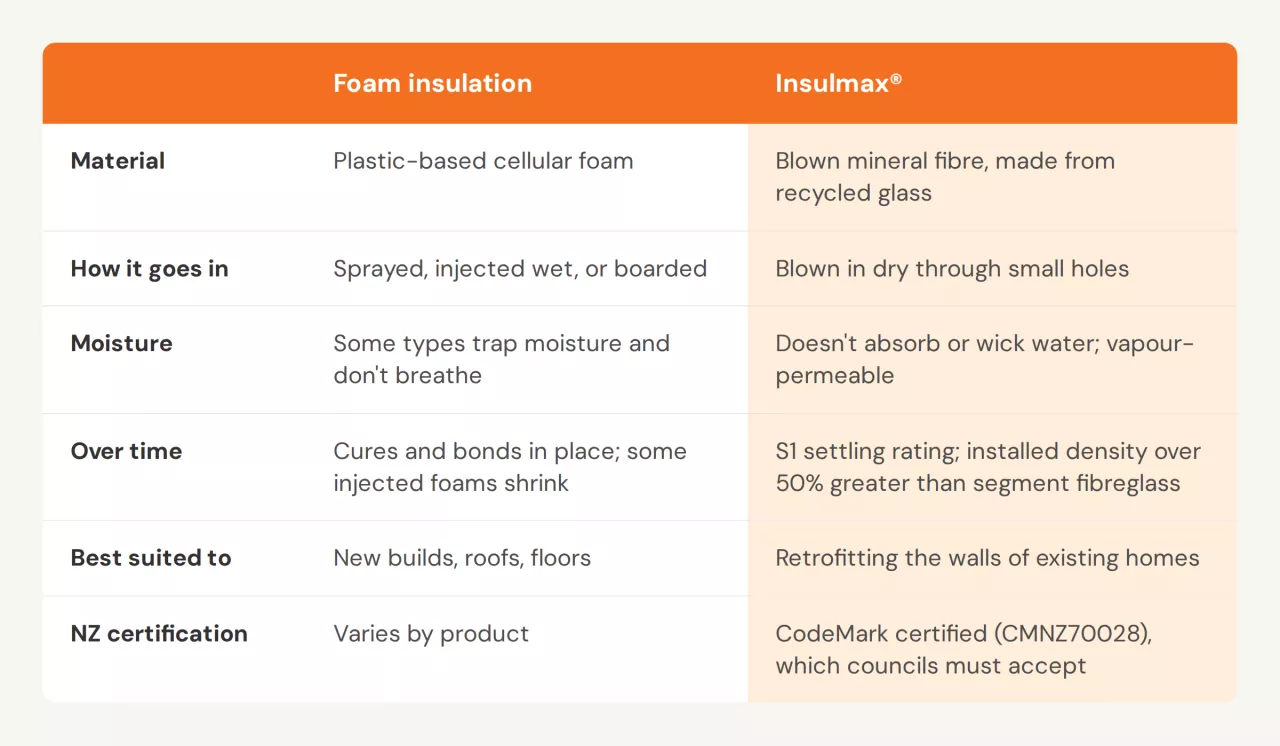 ®: material, how it goes in, moisture, how each performs over time, what each is best suited to, and NZ certification." width="1280" height="746" />
Which is right for an existing New Zealand home?
If you’re building, or renovating with the walls open, foam boards or spray foam may have a place. If your home is already lined and you want warmer, drier walls without taking anything off, that’s what Insulmax® was designed for.
The dry mineral fibre is blown in to fill each cavity, then the fill is checked with thermal imaging before the team leaves. Because it doesn’t absorb or wick water and stays vapour-permeable, it suits the older weatherboard, brick veneer and roughcast homes that make up so much of New Zealand’s housing. The work is backed by a 50-year written guarantee, and it’s generally installed within a day.
Is Insulmax® spray foam?
No. Insulmax® is a blown mineral fibre, not a plastic foam. It doesn’t expand, cure hard or bond to your framing.
What is the soft white material blown into walls?
For Insulmax® it’s mineral fibre, spun from recycled glass and treated to repel water. It won’t rot, hold moisture, or support mould or vermin.
Can insulation be injected into existing walls?
Yes. That’s what a retrofit system does. Insulmax® is blown in through small holes, so there’s no need to remove wall linings. Whether it stays put is covered in the settling article: one New Zealand wall opened nine years after install still had the fibre packed to the top plate.
Does blown-in wall insulation need a building consent?
Yes. Insulating the external walls of an existing home needs a building consent or a council exemption. Your local Insulmax® representative prepares and lodges the application as part of the process.
If your older home never quite holds its warmth, the walls are often the missing piece. Book a free, no-obligation home assessment and your local Insulmax® representative will measure the walls, show you the product and give you a quote.
Read more
Is Insulmax® certified in New Zealand?